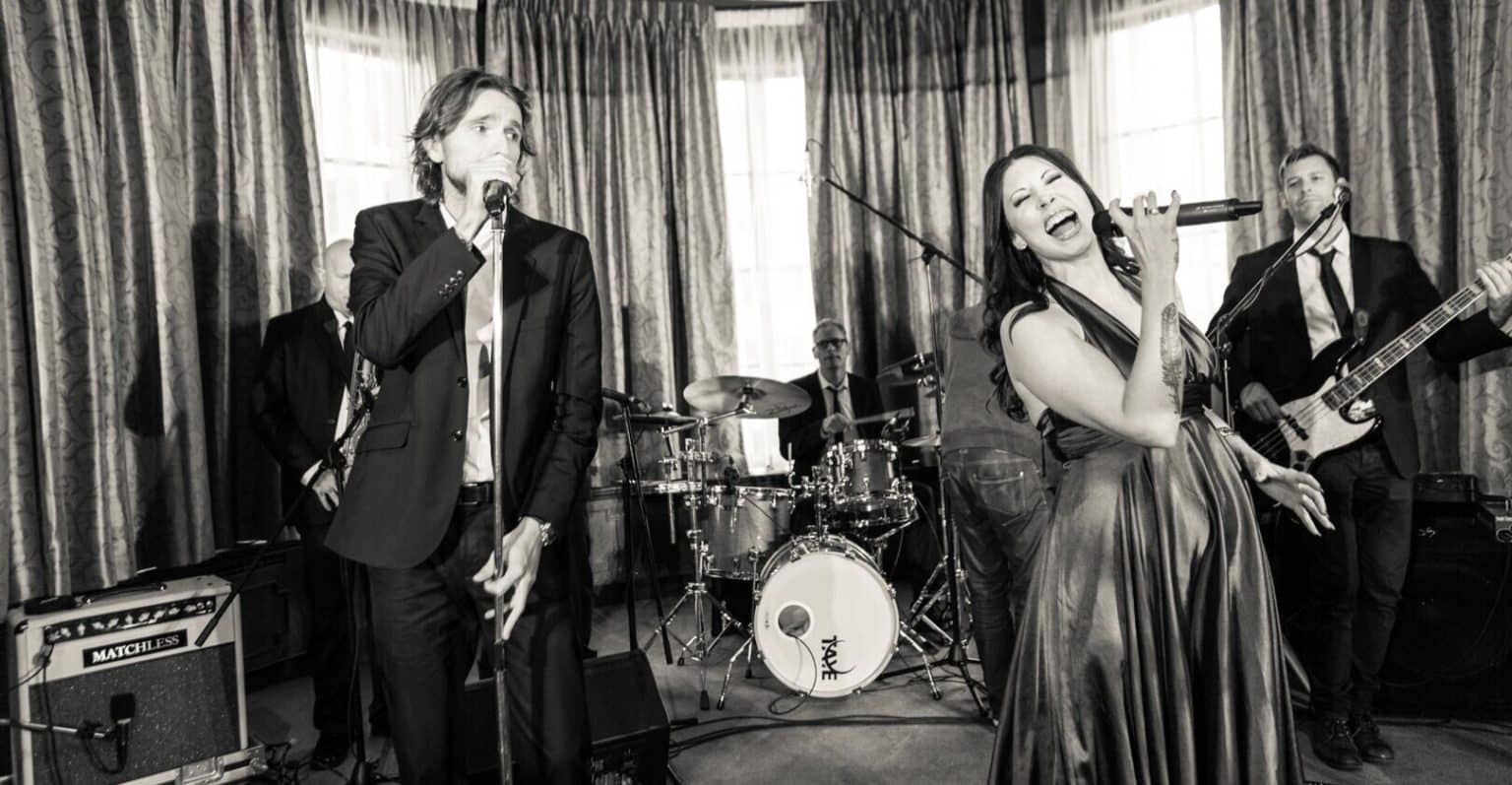
How Side One prices your band
There are many bands out in the world that will play your wedding. They obviously range from amateurs to Justin Bieber… I speak from experience, as I have literally played a wedding with Justin Bieber, hahaha.
Let’s eliminate your cousin’s band or Beyoncé from the possibilities and talk only about, say, the “top” wedding bands in your area. Even here, the range can be a bit wide when it comes to both price and talent.
How we price Side One is by asking a few questions, and this doesn’t just apply to weddings but most events:
- Where is it?
- Will there be dancing or no dancing, or a combination of both?
- Do you need us to provide production (mics, speakers, lights for the band, etc.) and, if so, for how many guests?
- What is the timing of the event?
- What type of music are you looking for?
- Anything else?
Let’s work through those questions, starting with travel.
Where do we go now, where do we go?
Travel tiers and Side One:
Local
Side One has different tiers of travel, and our pricing usually begins with how far the event is from the city centre. Across our four cities, the distances are roughly the same, although folks in Toronto will argue that driving 60 kilometres out of the city is a lot different than driving 60 kilometres outside Calgary. One might take three hours depending on the time of day, and the other might take 30 minutes. Either way, if the band can go home between soundcheck and the gig, that’s what we call “Local.” Often, that’s within about 60 kilometres in Canada or 40 miles in Seattle.
As we start getting beyond Local, the prices rise to accommodate the fact that the musicians are now committed for more of the day. As a comedian once remarked, “I tell the jokes for free; it’s the travel that I charge for.”
Local Plus
The next tier is far enough away that no one would come home after soundcheck, but they wouldn’t need a hotel when the event is over. This is what we call “Local Plus.” Occasionally, we will require one hotel room for our techs, as they are the first on site in the morning and the last to leave after packing everything up. These days can be 20 hours from the time they leave the shop to when the gig is all packed up at the end of the night. The hotel room can also work as a day room for the band to shower and get changed. We also add a mileage charge when we step beyond Local.
Tier 1
The next tier is what we call “Tier 1.” This is generally farther out from the city centre, and we usually require hotel rooms for the band and production team. For Vancouver, this includes Whistler; for Calgary, Banff; for Seattle, Portland; and for Toronto, Muskoka or London. The actual travel time and event schedule help determine the tier.
Tier 1 Plus
“Tier 1 Plus” is places like Victoria or Nanaimo, where, although the driving distance may be minimal, we also have a ferry ride of around two hours. The same goes for somewhere like Roche Harbor or Orcas Island in Washington State.
Tier 2
“Tier 2” usually kicks in when the event is more than 200 kilometres from the city centre. This would be somewhere like Kelowna or Vancouver Island beyond Nanaimo or Victoria; Jasper or Lloydminster; Sudbury or Montreal; or Bend, Oregon, or Spokane. Often for these, we’ll send our production team a day early to start setting up bright and early on event day, ready for the band’s arrival for soundcheck.
Tier 3
When we have to start getting visas, flights, etc., this gets us into “Tier 3” territory. Side One has had the pleasure of playing at all sorts of amazing destinations: Cancun, Maui, Florida, Scottsdale, Phoenix, San Francisco, Colorado, Moab, Carlsbad, West Virginia, Kiawah Island, Palm Springs and the Hamptons.
While we love travelling to these places, it also asks a lot of our musicians. There are the travel days to consider—remember that these musicians are the best of the best and could likely book three local gigs instead of one destination gig with two travel days. Then there are non-refundable flights and visas that commit them to these gigs, even if something else pops up for them.
Do you wanna dance?
Is it going to be a dance party rager or a little more chill? Or possibly both? We’ve now worked out WHERE your event will take place. Next is WHAT you’ll need us for.
We have about 150 services between live music and production (8 piece dance band, dinner audio management using dance band sound system, duo piano/male vocal, added additional lapel mic for officiant, etc.). For live music, one question helps narrow things down: will there be dancing? The answers are yes, no, or both—definitely or maybe.
Acoustic dance bands
If the answer is yes, our dance bands come in two varieties: acoustic and electric. Our acoustic quartet and quintet are great options for small venues and guest counts. The quartet is acoustic guitar, percussion, a female singer and a male singer. The quintet adds bass guitar.
If you’re unsure whether there will be dancing but want to keep the option open, the acoustic bands are a perfect fit: quiet enough for a dinner set that everyone can talk over and loud enough to rock the dance floor if one should break out. We can do the entire Side One set in this format, and it’s really fun to hear “unplugged” versions of Dr. Dre, Pitbull, AC/DC or Lady Gaga.
Electric dance bands
More common are our full electric dance bands. This is what Side One was built around, and it remains the foundation of what we do. Here’s how the band sizes build:
- 6 piece: male vocal, female vocal, electric guitar, keyboards, bass and drums.
- 8 piece: add tenor saxophone and trumpet to the 6 piece.
- 10 piece: add two background vocalists to the 8 piece.
- 12 piece: add a second trumpet and baritone saxophone to the 10 piece.
- 14 piece: add percussion and a second guitar to the 12 piece.
We also have specialty bands:
- 16 piece: the 12 piece plus a string quartet.
- 18 piece: the 14 piece plus a string quartet.
- 7 piece country/rock band: the 6 piece plus a second guitar.
- 9 piece country/rock band: the 7 piece plus pedal steel and fiddle.
- 11 piece country/rock band: the 9 piece plus two background vocalists.
The point is simple: more musicians, more money. Beyond Local, that can also mean more vehicles, hotel rooms, ferry fares, visas and/or flights. Our sales team can quote the band you’d like along with the travel costs that go with it.
I’ve written about the perfect band size for your party here:
Music for the rest of your wedding
The upside is that once you hire a dance band, you have a bunch of musicians “in the door.” We can start building out the other parts of your wedding with live music for a fraction of the cost of bringing in independent musicians for each portion of the day. Adding a guitarist or pianist for your ceremony, for instance, is easy because our dance band musicians are on site are fully equipped to play these parts of your event.
This brings us back to dancing versus not dancing. For the ceremony, cocktail hour and dinner, we have plenty of configurations depending on the mood you want to create. And it doesn’t all have to wait until after dinner: one trend we’re seeing is the “Twilight Hour Set,” a short dance set as guests enter the reception after the ceremony and cocktails. Jewish weddings have been doing this for years as this is typically when we do “The Hora” which you can read about HERE.
Ceremony music
For ceremonies, we usually suggest a solo musician. There’s a certain amount of improvising involved in ceremonies. Some processionals take a long time and some are short depending on the length of the walk and number of people in the wedding party, so song lengths and endings need to adjust on the fly. That gets harder to communicate with more musicians. That said, it’s not too difficult to whisper “chorus again” to a singer, so a duo can work nicely too. So common options are:
- Instrumental acoustic guitar or keyboard solo. I say keyboard, but if your venue has a tuned grand piano, we’re happy to use it!
- Acoustic guitar or keyboard duo with a singer.
If you have your heart set on a violinist or string musicians, we’re happy to recommend some for you to book directly.
A ceremony is typically about 30 minutes long, and our ceremony musicians start 30 minutes before it begins so there’s music as guests arrive. No one hates awkward silence more than us. Throughout your event, if no one is speaking, there should be music, whether it’s a playlist or a live musician. Period.
If you need a microphone for your officiant, or just want a playlist for the ceremony, we can add a sound system with a tech to manage it. If you’ve hired a ceremony duo with a singer, the sound system is included; we’d just need to add the wireless mic and tech to manage it.
Cocktail hour and dinner music
We usually suggest our acoustic solos, duos and trios for cocktail hour, and our jazz groups for dinner. But the reverse—or the same group for both—can work too. Whether it’s instrumental or vocal, jazz or pop, the same idea applies like travel: more people, the cost will increase.
Our acoustic options build like this:
- Solo: guitarist/vocalist covering pop tunes, including some that might surprise and delight.
- Duo: add another guitarist for leads and background vocals.
- Trio: add a percussionist to the duo.
- Quartet: add a female vocalist to the trio.
This video HERE builds the solo to the trio which is fun to see.
For jazz, we offer instrumental and vocal groups:
- Instrumental duo: piano or guitar and upright bass.
- Instrumental trio: piano or guitar, upright bass, and saxophone or drums.
- Instrumental quartet: piano or guitar, upright bass, saxophone and drums.
- Vocal duo: piano or guitar and vocalist.
- Vocal trio: piano or guitar, upright bass and vocalist.
- Vocal quartet: piano or guitar, upright bass, vocalist, and saxophone or drums.
- Vocal quintet: piano or guitar, upright bass, vocalist, saxophone and drums.
Sound systems and production
Another question is WHERE in the venue each part of the wedding is happening. If the ceremony, cocktails and dinner are in different areas, will we need additional sound systems? Even if you only want a playlist, someone still needs to provide speakers in each space, whether that’s us or the venue.
Dinner Audio Management
Nine times out of ten, dinner is in the same area as dancing, so the sound system we’ve set up for the dance band can also be used for dinner. In that case, most of our clients opt for what we call “Dinner Audio Management.”
This plants our sound tech at the mixing board for the entirety of dinner. They’ll play a background playlist—or mix the live music if you’ve chosen that—provide a wireless handheld microphone for speeches and toasts, and make sure those speeches can be heard. Uncle Bob might not have a lot of experience with mic technique during his toast to his niece.
A microphone needs a little more support than a pair of speakers. A tech manages the levels and keeps an ear out for feedback or wireless interference. We’re happy to provide the equipment and the people to run it, and we can explain what’s needed alongside anything your venue already supplies.
How long does the band play?
Timing affects the quote too. How much music do you want, over what period, and which musicians are playing earlier in the day? You can add more time, but it comes at an additional cost.
Dance band sets
Our dance band booking includes three hours of music within a four-hour window. Usually, we play two 90-minute sets with a 30-minute break. We’ve found that the more breaks you take, the more people are inclined to leave the party. Those long sets are quite exhausting for our team, so the 30-minute break is important, but we find this format makes for the best party.
Two 90-minute sets and a 30-minute break add up to three and a half hours, leaving 30 minutes of wiggle room within that four-hour window. If dinner or speeches run behind—more often than not, they do—we can shift the sets within that window without losing playing time. We can also do three 60-minute sets with shorter breaks if you prefer.
We also can offer our 2 hour power set which is 120 mins straight through without a break. 90 mins is already an intense amount of time to play non stop, but we can offer the 2 hour IF that’s the only set that the dance band is doing.
I’ve written more about this in How Do I Plan Music for My Event?
Cocktail hour and dinner sets
For cocktail hour musicians, our usual limit is 90 minutes max, but let us know if you need longer. Ninety minutes is a long time to play without a break, so if you need a musician for two hours, they’ll likely take ten minutes somewhere in there.
For dinner, our usual limit is two hours max, as there are likely to be built-in breaks for toasts and speeches. We also ask for a buffer between the dinner musicians finishing and the dance band starting, particularly when the same musicians are doing both. That gives them a chance to take a break and eat dinner before they start rocking with the band.
Special requests and other extras
Beyond travel, musicians, services and timing, a few specialty items can affect the price:
- Themes: costumes for an ’80s party, for example, or learning new repertoire to bring the theme to life.
- Special song requests: every booking includes one free song learn—not “Bohemian Rhapsody” please! If there’s another song you absolutely must have, there may be an additional cost.
- Rentals: sometimes a musically inclined bride or groom wants to surprise the guests by sitting in with the band, but understandably doesn’t want to haul an amp to their own wedding. We can generally supply extra equipment for a small fee.
- Multiple locations: if the ceremony is off-site from the reception, we’ll need to allow for extra travel. We may also need another tech to pack up equipment if the primary tech is needed at the next location right away.
- Power: if the venue can’t provide adequate power and we need to bring generators, there can be an additional fee.
So how much will your wedding band cost?
The answer comes back to those first five questions. Where are we going? Are we starting a dance party, keeping things a little more chill, or doing both? What equipment do we need, how long are we there, and what do you want to hear? A six-piece band playing a local reception is a different plan from an eighteen-piece band travelling for a full wedding day, and the quote needs to reflect that.
Tell us what you’re imagining and we’ll help you work through the options, from the first guests arriving to the last song of the night. We can explain where the money goes and help you decide where you want to spend it. Whether that’s an acoustic quartet or a full band with horns and strings, the goal is the same: music that feels like you, and a wedding your guests will still be talking about on the way home.